

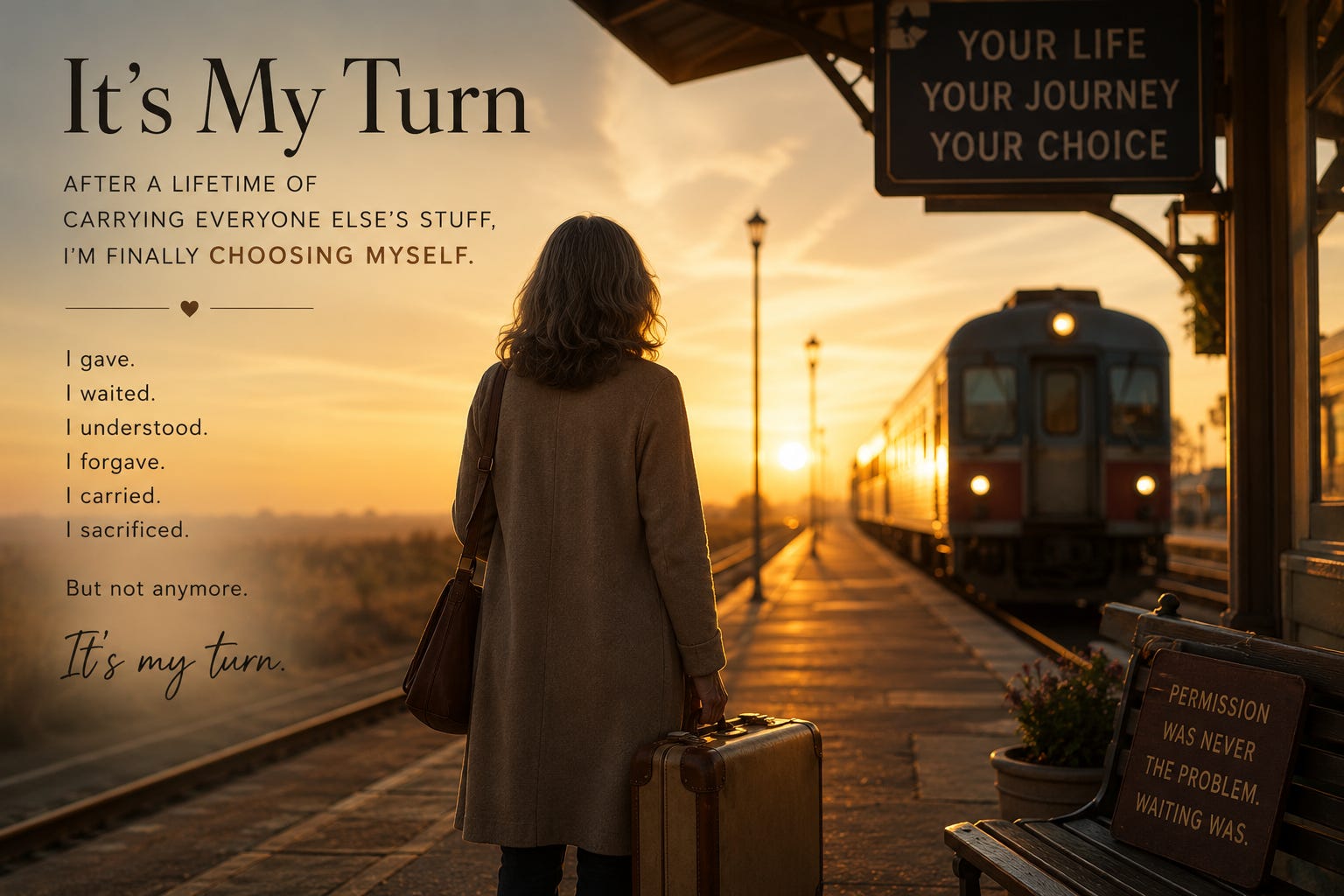
It’s My Turn
After a lifetime of carrying everyone else’s burdens, I’m finally choosing myself.

Lately, I’ve been wrestling with an uncomfortable thought that’s difficult to admit out loud.
What if I’ve wasted my life? Not entirely, of course. I’ve built a business I’m proud of where I’ve helped people navigate some of the most important transitions of their lives. I’ve loved deeply and learned difficult lessons. I’ve experienced profound loss balanced with moments of extraordinary joy.
Yet there are days when I look around and wonder what might’ve happened if I’d devoted as much energy to my own becoming as I devoted to everyone else’s. That thought returned after Tim died.
At first, I believed I was simply grieving the loss of a good man. And I was. But as the weeks passed, I began to realize that my grief wasn’t only about Tim. It was about what his loss uncovered. Tim wasn’t family, at least not in the traditional sense. Yet over the years, he became a part of my life in a way that felt reassuring and comfortable.
Of course, he cared for my lawn and shoveled my snow as he had done for my mom. But what I valued most was never the work itself. It was his steady presence. His kindness. The way he noticed things. The way he checked in. The quiet, unassuming way he made me feel cared for.
As I’ve reflected on his loss, I’ve realized that part of what made our connection so meaningful was that he represented something I had been missing for a very long time. My brother Paul died when I was only twenty-one. I never had the chance to know the man he would become, but I often imagine he would have been loving, protective, and thoughtful. Someone who checked in simply because he cared. Someone who would’ve remained a steady presence throughout my life.
In some ways, losing Tim awakened an old grief I probably hadn’t fully worked through. Because it wasn’t only grief for Tim. It was grief for Paul. Grief for the brother and the lost chance to grow old with him. And perhaps grief for the kind of adult sibling connection I quietly wished for but have never fully realized.
In some small way, Tim filled a corner of that space. Not because he replaced my brother. No one could. But because he offered something simple and precious: the feeling that someone was looking out for me, not because they had to, but because they genuinely cared.
When Tim died, I lost a connection to something I had quietly treasured for years without fully understanding why: the feeling of being cared for in a way that asked for nothing in return.
For weeks afterward, I found myself asking: Why did this loss hit me so hard? Because grief has a way of exposing more than the loss directly in front of us. It illuminates everything connected to it. As I sat with my sadness, I began to realize that I missed what he represented. A relationship that felt easy. A connection that didn’t require me to earn it. A kindness that wasn’t dependent on what I could do, fix, provide, or sacrifice. And that realization forced me to look more honestly at other relationships in my life.
Some are built on mutual care. Some are not. And the differences can surprise us. For perhaps the first time, I’ve stopped asking why certain relationships feel so difficult and have started asking a different question: Why have I spent so many years believing it was my responsibility to heal the wounds and keep these relationships alive?
What I realized is that for much of my life, I have taken responsibility for issues, conflicts, disappointments, and struggles that were never mine to carry or resolve. I was the one who reached out. The one who forgave. The one who adjusted. The one who explained away behavior that hurt me while searching for common ground. I believed that if a relationship wasn’t working, surely there must be something more I could do. Something more I could understand or give or sacrifice.
What I rarely considered was that maybe the responsibility wasn’t mine. Maybe I wasn’t the one breaking things. Maybe I wasn’t the one failing. And just maybe I was carrying the full weight of relationships that only appeared to work because I was doing all the heavy lifting.
That realization has been both painful and liberating. Painful because it forces me to acknowledge how often I’ve accepted much less than I deserved. Liberating because it means I can finally stop trying to earn acceptance that should have been a natural outgrowth of a relationship.
And yet, if I’m honest, I helped create the conditions for that pattern. I became so accustomed to giving, accommodating, understanding, and waiting that I stopped noticing how often I was putting myself last. For much of my life, I fit myself into the cracks and crevices left behind as others pursued their lives.
Meanwhile, I waited. I waited to feel seen. I waited to feel chosen. I waited for the right opportunity, the right invitation, the right timing. I waited for acknowledgment. I waited for apologies that never came.
Most of all, I waited for permission. Permission to stop putting myself last. Permission to take up more space. Permission to pursue what mattered to me without being told I was selfish, irresponsible, or undeserving. I lived in this corner believing that permission would eventually arrive. That one day I would have done enough. Sacrificed enough. Proven enough. Or simply waited long enough. Then life would finally open the door.
But the truth is that later isn’t a promise. It’s often a story we tell ourselves when postponing our own lives feels easier than risking disappointment. And perhaps the hardest realization of all is that my waiting wasn’t only about obligation. Part of it was fear. Not fear of failure or success or simply being misunderstood. It’s something deeper.
It’s the fear that if I stopped giving, stopped carrying, stopped accommodating, stopped being the one who reached out, fixed things, forgave, and held everything together, I might discover something I wasn’t sure I could bear.
Because if people stayed only when I was giving them something, what would happen if I simply showed with only me to offer them? What would happen if I stopped earning my place and expected to belong anyway? What if the very people who were supposed to love me left? What if they abandoned me? What if the very thing I have feared all my life turned out to be true?
That realization hit me harder than I care to admit. I began to understand how much of my life has been shaped by the fear that I would not be loved, chosen, or valued unless I was constantly offering something in return.
I’ve spent years helping others claim their lives. I’ve encouraged people to stop shrinking, stop waiting for approval, and stop allowing other people’s expectations to dictate their choices. I’ve helped them recognize their value, trust their voice, and step into possibilities they once thought were beyond their reach.
Yet quietly, and often invisibly, I’ve still been questioning whether I was entitled to do the same.
Whether I’d earned the right to take up more space or want more. Whether the life I wanted needed someone else’s approval before I could begin living it. I’ve spent years helping others claim their lives while quietly questioning whether I was entitled to claim my own.
I suspect many women understand this. We become caretakers of other people’s dreams. We make sure everyone around us is supported, encouraged, comfortable, and moving forward. We become so skilled at helping others build meaningful lives that we rarely stop to ask whether we are building our own.
Then one day, a quiet ache appears. That feeling of being left behind. Forgotten. I’ve been there often in my life. We’ve simply spent years standing on the platform, waving as train after train carried others toward the lives they chose, while convincing ourselves that our turn would come someday.
What I’m finally beginning to understand is that permission to live as fully and unapologetically as I encouraged others to live was never required in the first place. So, what’s been keeping me from moving?
Fear. It’s that left-behind thing but more nuanced. I’ve realized that not everyone will understand when I finally decide to board my own train. Some people have become accustomed to the version of me that waits, gives, accommodates, makes room, and carries more than my share.
And when I stop doing that, they may not applaud. They may not understand. They may even resent it. Not because I’ve done something wrong, but because the role I’ve always played is no longer available. They may try to keep me from getting on board, knowing I’d acquiesced in the past.
But the gift of recognizing this truth is that it leaves us with a choice. We can continue standing on the platform, waiting for approval, understanding, acknowledgment, or validation. Or we can step onto our own train anyway. Not everyone will like it. Not everyone will understand it. But at some point, we have to decide whether we want to spend our lives waiting for permission or living fully.
As I continue to grieve, wonder, imagine, question, and, as my mother would probably say, “think too much,” I realize I don’t have all the answers. I may never figure it all out. I’m still learning to feel confident letting go of responsibilities that were never mine to carry. Still discovering who I am when I stop defining myself through the needs, expectations, and approval of others.
But I do know this.
I don’t want to spend the rest of my life apologizing for taking up space in my own story. I don’t want to keep shrinking so others can feel larger. I don’t want to keep waiting for permission that was mine all along.
Because if losing Paul, losing Tim, losing my parents, and losing so many versions of my life has taught me anything, it’s this: Life is far too precious to spend it standing on the platform waving while everyone else boards their train.
For years, I thought my turn would come when someone finally chose me. When the relationship improved. When the invitation arrived. When the timing was right. When I had done enough to deserve it.
But standing here now, I can finally see what I couldn’t see before. My turn was never something another person could give me. It was something I had to claim. Scary as that might be. So, the next time the train arrives, I intend to get on. Not because I’m no longer afraid. Not because I know exactly where it’s headed.
But because I’ve spent enough of my life watching everyone else leave the station. It’s my turn.
If this reflection resonated, I share a short morning note each weekday. It’s a quiet space for clarity, courage, and aligned action.
If you’re already a subscriber, thank you for walking this month with me.
If you’re reading along but not yet receiving the daily notes, you’re welcome to join us. I’d love to have you there.
If this resonated with you, I’d love to know.
About the Author
Laura Johnson is the creator of Fearless Authenticity, where she explores self-trust, grief, growth, relationships, and the stories that shape who we become.
This definitely resonates with me. I’ve never felt I fit into the success driven life so I chose to have and raise a family. Sure I worked at various times outside the home even enjoying those jobs but they never felt like my calling. Even though I loved my family & wanted to care for them, I always felt like I was missing something. Now at 69 I find myself reflecting back on my life. No clear answers but I do have a better understanding of why I never pursued many additional hobbies or interest. And I am finding more self acceptance and love.